Open mobile app
D Byk Store
Hello! Need help? Don’t worry, I’ve got you. Tell me what’s up, and I’ll be happy to assist 💁
Add 1 scoop to 450ml of cold water or your favourite beverage. Blend using a blender until smooth. Consume Daily
Serving Size: One Scoop | 30
Active Ingredients per Serving (1 Scoop - 37g)
Flavour- Cocoa Chocolate Flavour.
Other Ingredients- Cocoa Powder, Encapsulated Cocoa Chocolate Flavour, Encapsulated Creamy Vanilla Flavour, Steviol Glycosides (INS 960).
Protein is a very large nutrient that’s made up of smaller substances called amino acids and they are one of the most important substances in your body that helps to repair and maintain your body tissues.
For example, our muscles are formed from an intricate matrix of protein fibers. Every flex, every bench press, and every movement of our muscles is the result of these protein fibres working in synchronicity. These muscle fibres are in a high state of dynamic motion in athletes and active individuals as they are constantly broken down and rebuilt during exercise. After intense workouts, the body is starved for protein, and in the absence of additional protein intake, the body may start to leach protein away from muscles, thus athletes and active individuals have higher requirements of protein, as the body needs the building blocks to recover from this muscle damage and initiate the process of building new muscle.
Supplementation with a suitable and complete protein source helps hinder this breakdown of muscle protein, enabling individuals to retain and build lean muscle mass and promotes adaptations in response to training and facilitates the replenishment of energy stores and glycogen in muscle post-exercise. Additional protein intake is also key to comprehensive muscle recovery after endurance activities – studies have shown that protein aids in the repair of muscle damage induced by high-intensity exercise [1].
Now, we know that builders and athletes need extra protein to cope with body requirements. But our body is not equipped to naturally break down and optimize the large amounts of protein. Excess protein that goes undigested in the small intestines could move into the colon where bacteria will break it down, creating ammonia that is difficult to neutralize and may build up over time. And while the body can handle small amounts of ammonia, large amounts of protein can produce more ammonia than the body can handle on its own, leading to compromised immune systems and even cell damage. Some common symptoms associated with undigested protein include gas, bloating, and diarrhea. The solution lies with enzymes that can break down food particles into an appropriate size for digestion. The problem is that enzymatic activity naturally decreases with age. Today’s diet is largely devoid of enzyme activity since enzymes are typically destroyed by food preparation and processing techniques that involve high temperatures. Supplementation with enzymes is one way to meet the digesting demands of high protein.
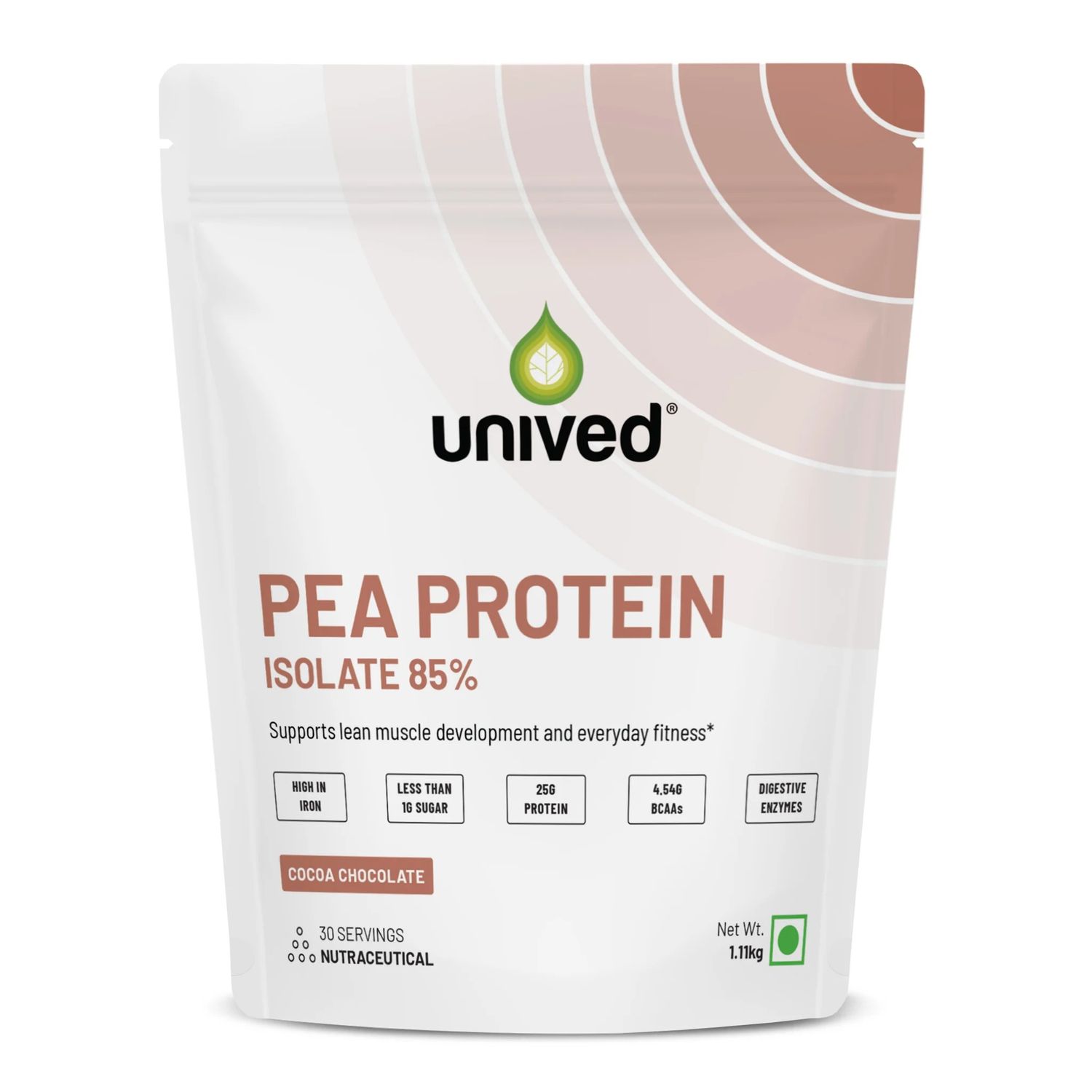
Unived Pea Protein Isolate offers a complete source of protein with natural digestive enzymes to make sure that the protein is easily digested and available to the body for absorption and utilization.
Our Formulation
Unived Pea Protein Isolate is a completely vegetarian and vegan formulation that offers
25 grams of plant-based pea protein from yellow peas which have
Pea protein has a high PDCAAS score of 0.93 which means it scores high on both – the quality of the protein, and the digestibility.
It also offers a natural digestive enzyme blend that has
All these digestive enzymes act at different pH and are temperature stable.
Unived Protein is Non-GMO, sugar-free, hypoallergenic, cholesterol-free, dairy-free, gluten-free, and soy-free supplement.
Mode of Action:
Pea Protein Raw: Helps build lean muscle mass and aids muscle recovery.
Natural digestive enzymes: Initiate the digestion of protein and hydrolyzes them to a small polypeptide for better digestibility, absorption, and utilization.
References:
1. Protein Supplementation in Athletes, httpp://www.sportsmd.com/sports-nutrition/protein/protein-supplementation-athletes.
2. Armsey Jr, Thomas D., and Todd E. Grime. "Protein and amino acid supplementation in athletes." Current Sports Medicine Reports 1.4 (2002): 253-256.
3. Shimomura, Yoshiharu, et al. "Exercise promotes BCAA catabolism: effects of BCAA supplementation on skeletal muscle during exercise." The Journal of nutrition 134.6 (2004): 1583S-1587S.
4. Maxwell, Andrew J., et al. "L-arginine enhances aerobic exercise capacity in association with augmented nitric oxide production." Journal of applied physiology 90.3 (2001): 933-938.
5. Castell, Linda M., and Eric A. Newsholme. "The effects of oral glutamine supplementation on athletes after prolonged, exhaustive exercise." Nutrition 13.7-8 (1997): 738-742
Hello! Need help? Don’t worry, I’ve got you. Tell me what’s up, and I’ll be happy to assist 💁